AI Social Media Management for Founders With No Time
October 14, 2026

AI social media management means letting software handle the two steps founders skip: cutting one piece of work into platform-shaped posts, and putting those posts on a schedule you never have to remember. It does not decide what you should say, and it cannot tell whether a post sounds like you. Those two jobs stay yours, and they take about twenty minutes a week once the rest is running.

Most founders do not have a social media problem. They have a repurposing problem. You already wrote something worth reading this month. The posts are inside it, and pulling them out by hand is the task that keeps sliding to next week.
What does AI social media management actually do?
Four jobs, and only one of them is writing.
| Job | What the tool does | What it replaces |
|---|---|---|
| Reshaping | Cuts a long draft into a post, a thread and a carousel outline | Your blank-page hour |
| Scheduling | Queues each variant into a slot you chose | The Sunday catch-up |
| Repurposing | Reuses a post that worked three weeks ago | Copy, paste, reformat |
| Reporting | Pulls impressions and saves into one view | The spreadsheet you built once and abandoned |
The reshaping is where the time goes. A founder with one solid article has five or six posts inside it, and finding them is mechanical work a model does well.
Why this is worth automating now
Attention has not moved to social in the last decade. It has always been there, and the platforms have gotten better at deciding what each person sees.
Internet users spend an average of 141 minutes a day on social platforms (Statista). That is the audience. The constraint is that the platforms no longer reward posting volume the way they once did.
Instagram performance tightened through 2025, with engagement down roughly a quarter year over year and follower growth slowing across every brand size (Socialinsider). Buffer's guide to how the Instagram algorithm ranks content puts the emphasis on sends, saves and watch time rather than raw frequency (Buffer).
Read those two together and the conclusion is uncomfortable for anyone automating volume. Posting more, worse, is now a losing strategy. Posting a smaller number of things people actually save is the only version that works. That is exactly the job a founder with two hours a week cannot do by hand, and exactly the job software can.
The three jobs worth automating first
Automate in this order. Each step removes work from the next.
- Scheduling. Pick three slots a week and fill them in advance. This is the cheapest win, because it removes the daily decision, not just the daily task.
- First-draft reshaping. Give the tool a source document, not a blank page. A post written from your own article carries your argument, so the draft needs editing rather than rewriting.
- Repurposing. Anything that earned saves or replies gets a second life six weeks later, rewritten for a different platform. This is the highest-return step and the one almost nobody does.
Notice what is missing: ideation. Asking a model to invent topics for you produces generic advice, because it has nothing specific to work from. Your own work is the input.
What to keep doing yourself
Three things, and they are not negotiable.
- The point of view. Every post should carry a claim someone could disagree with. A model will flatten your opinion into a balanced summary unless you tell it what you actually think.
- The first sentence. Openers are where drafts go soft. Rewrite yours by hand; the rest can stand.
- The reply. When someone comments with a real question, answer it yourself. That is where the audience is actually built, and it is the part nobody can do for you.
Everything else, from hashtag formatting to posting times, is administration.
A five-day social workflow for one founder
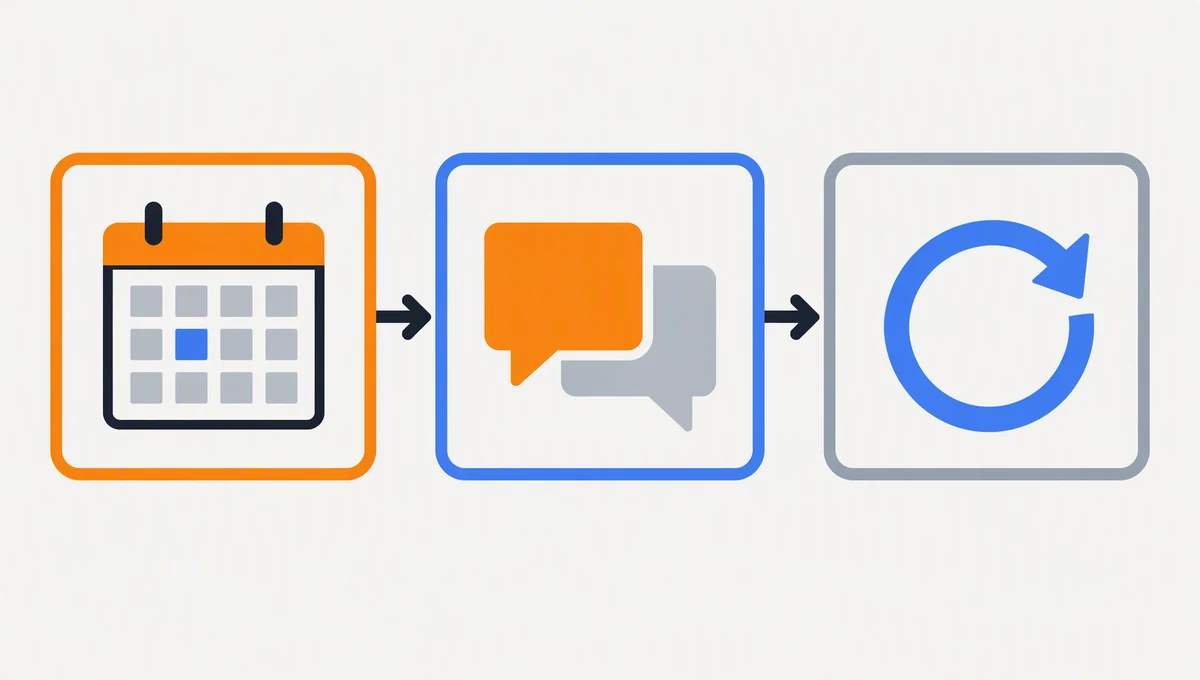
This is the loop that keeps the whole thing under an hour a week. It assumes one long piece of work published this month, which you almost certainly have.
| Day | Task | Time | Where |
|---|---|---|---|
| Monday | Paste the article into the tool, ask for five post variants | 15 min | Laptop |
| Monday | Pick the two that sound like you, delete the rest | 10 min | Laptop |
| Tuesday | Edit the first sentence of each by hand | 10 min | Laptop |
| Wednesday | Fill three slots for the next seven days | 5 min | Phone |
| Friday | Answer every reply yourself, note the question people keep asking | 15 min | Phone |
| Friday | Save the best-performing post for the six-week repurpose | 2 min | Laptop |
Total: under an hour. The Friday note matters more than it looks. The question people keep asking is your next article, and it arrived for free.
How to brief the tool so the posts sound like you
The quality of the output is set entirely by the brief. Four lines are enough.
- Who is reading. Not a demographic, a situation. "A technical founder who has never run a campaign" beats "startup founders".
- What the post has to say. One sentence, your claim, in your words.
- What it must not say. List the phrases you never use. Every founder has three.
- The shape. "Four short paragraphs, no hashtags, ends with a question" is a brief. "Write a LinkedIn post" is not.
The fourth line is the one people skip, and it is the one that determines whether the draft is usable. Format is free to specify and expensive to fix afterwards.
Keep the brief in a note and paste it every time. Rebuilding it each session is how a fifteen-minute task becomes an hour.
What AI still gets wrong on social
Three failure modes worth knowing before you trust a draft.
It hedges. Ask for a take and you will get a summary that lists both sides. If your post does not commit to a position, it will not be saved, and it will not be replied to.
It over-explains. Models default to context. Social rewards compression. Cut the first sentence of any generated draft and read it again; it usually improves.
It cannot see your feed. The tool does not know that a competitor just launched, that your audience spent the week arguing about pricing, or that a phrase has gone stale. You are the only one holding that context, which is why the twenty minutes you spend is the twenty minutes that matter.

How do you measure whether it is working?
Ignore impressions for the first month. They move for reasons unrelated to your writing.
Track three numbers instead.
| Metric | Why it matters | Where to find it |
|---|---|---|
| Saves | The clearest signal that something was worth keeping | Post insights |
| Replies from strangers | Reach outside your existing network | Notifications |
| Profile clicks | Whether a post made someone curious enough to look | Account insights |
If saves are flat for six weeks, the problem is the argument, not the schedule. Change what you claim before you change how often you post.
What if you only have two hours a week?
Spend them in this order and stop when the time runs out.
- Hour one: one long piece of work. An article, a teardown, a recorded answer to a customer question.
- Hour two: cut it into three posts, schedule them, and reply to everything.
One long piece a week beats five improvised posts, because the long piece compounds. It ranks, it gets linked, and it feeds the social schedule for a month.
If you cannot find the hour for the long piece, the problem is upstream of social. The weekly marketing plan for startups shows how to protect that block, and what an AI CMO does explains where the planning layer sits relative to the tools you already pay for.
The short version
AI social media management is worth using for exactly two things: turning your own work into platform-shaped drafts, and getting those drafts posted without you thinking about it. Keep the opinion, the opener and the replies.
One practical note on where this fits. The weekly planner BrandOye builds treats social as one task inside a plan that also covers search and your long-form work, which is the right frame: social is a distribution channel for something you made, not a content factory of its own. If you want to see how that reads as a weekly plan, the pricing page shows what the plans include.
Pick three slots. Fill them from work you already did. Reply to everyone. That is the whole system, and it survives a busy week, which is the only test that matters.